

Will the Most Important Person in the Room Raise Your Hand?

Some people mistakenly believe that more education or a higher title makes them more significant.

If you believe you’re the most important person in the room, go ahead and raise your hand.

It sounds almost humorous when you say it out loud. And yet, haven’t we all been in spaces where someone silently, or not so silently, seems to carry that very belief? I know I have.

Here’s the truth: no one in the room is more important than anyone else.

This reflection has been on my heart since a recent experience at a restaurant. I was enjoying a quiet meal when I witnessed a customer loudly ridicule a waitress because her glass of water didn’t have ice. What could have been a simple request turned into a humiliating scene. The customer belittled the waitress’s job and even suggested she “go to college” and “be somebody.”

My heart ached for that waitress. No one deserves to be diminished over something so trivial, and certainly not for earning an honest living.

Every person matters. Every job carries value.

Think about it. Without servers, how would we enjoy the experience of dining out? Without the countless individuals who serve in roles often overlooked, many of the comforts we take for granted would simply not exist.

Some people mistakenly believe that more education or a higher title makes them more significant. But significance is not measured by degrees or job descriptions. It is measured by character.

Consider the example of Jesus Christ. In John 13:14 (NIV), He says, “Now that I, your Lord and Teacher, have washed your feet, you also should wash one another’s feet.” He didn’t just speak about humility, He demonstrated it. He washed the feet of His disciples, of sinners, and even of Judas Iscariot, the very man who would later betray Him.

That act alone dismantles the idea that status determines worth.

If the One called Lord and Teacher could kneel in service, who are we to stand in superiority?

Today, let us choose gratitude over arrogance. Let us extend kindness instead of criticism. Let us remember that dignity belongs to everyone, whether they are leading a company, serving a meal, or quietly doing work the world rarely notices.

And the next time we find ourselves in a room full of people, may we remember: we are important, but so is everyone else.

Christians Get a Bad Rap

Let me clear this up: Christians are not perfect. If we were, God would’ve already upgraded us to Heaven Premium.

I think Christians get a bad rap. Some people imagine we walk around glowing, clutching our Bibles, judging everyone like we’re on the Heavenly Olympics of Holiness. Spoiler alert: we’re not perfect. If we were, we’d probably already be in heaven sipping angel-inspired lemonade.

Let me clear this up: Christians are not perfect. If we were, God would’ve already upgraded us to Heaven Premium. We’re just regular people doing our best to become the person God had in mind when He made us, flaws, typos, and all. We’re kind of like a lifelong spiritual renovation project.

When we make a personal decision to believe in Jesus, it doesn’t mean we think we’re better than anyone else. It means we’re trying to live by heaven’s house rules while still surviving earth’s chaos. Earth is basically a temporary Airbnb, and heaven is the forever dream home with no drama, no hate, and definitely no internet trolls.

Now, heaven probably isn’t letting in people who thrive on being mean, messy, and full of negativity. Think of it like a gated community with strict Homeowner Association (HOA) rules. The Bible is like our version of Bylaws and Covenants, Conditions, and Restrictions (CC&Rs), with rules like: No haters, no troublemakers, and no bad vibes allowed.

Jesus is the gatekeeper, and we can only get to heaven through Him. And, friends, when I show up at heaven’s front door, I’m hoping my name is on the guest list. I dream of a place with zero gossip, zero hate, and absolutely no comment sections. That’s why I try to live with kindness, respect, love, and good intentions, because I figure that ups my chances of getting past the velvet rope.

Now, do I get it right all the time? Absolutely not. I’m human. Sometimes I mess up, trip over my own attitude, recognize my mistake, and say, “Lord, my bad.” I ask for forgiveness. The Lord forgives me, and I keep going. Every time I try again, I feel like I’ve levelled up spiritually.

I’m not here to force anyone to believe what I believe. You might not even think heaven or hell is real, and that’s your choice. I’m just explaining why I live the way I do. For me, loving beats hating. Kindness beats cruelty. And positivity beats being miserable any day.

So, if you see me trying to be good, just know I’m not acting holy, I’m trying to keep my reservation at Heaven’s All-Inclusive Resort.

Not Everyone Deserves Access to Your World

Protect your heart. Not everyone deserves access to your inner world.

Just because people want to be in your world doesn’t mean you need to give them access. Your world is sacred. And if you want peace in your life, you must be intentional about who gets close to you.

It took me a long time to accept that not everyone gets to be my friend. I learned that lesson through deep hurt from someone I once believed was a lifelong friend. Because we disagreed politically, she said things that made me feel less than human. Her words cut deeply. I cried for days, questioning myself, my character, and my worth. My heart felt shattered.

Then one day, my husband said to me, “Marlene, you’re the nicest person I know. Not everybody gets to be your friend.” And he walked away.

That simple statement changed my life.

It marked the beginning of my journey to release people who had no right to disrupt my peace or tear down my spirit. I understand that people act from their own wounds and beliefs, but when someone repeatedly brings harm into my life, I’ve learned to lovingly but firmly remove their access.

This isn’t about being arrogant or “holier-than-thou.” It’s about honoring who I am. You are you. I am me. We all deserve respect. If mutual respect isn’t present, there’s no obligation to stay connected.

If you know me, you know I’m all about love. Love yourself first. Love others as they are. We don’t have to agree with everyone, but we should treat everyone with dignity. And if you follow Jesus, you know His love is for everyone. He doesn’t discriminate. He loves unconditionally, and He calls us to love the same way.

Some people may test my patience, but even when I don’t particularly like someone’s choices or lifestyle, I choose to love them, pray for them, and wish them well, from a healthy distance.

To keep your soul at peace, be discerning. You don’t need to be loud, rude, or unkind. But you do need boundaries. Protect your heart. Not everyone deserves access to your inner world.

I pray you are always surrounded by the love you deserve. Live in love, peace, honor, and respect.

The Healing Power of a Hug

A hug can comfort a grieving heart, calm an anxious soul, or celebrate a victory that words would only cheapen.

There is something sacred about a hug.

There is something sacred about a hug.

A hug requires no explanation, no eloquent words, and no perfect timing. It is a silent language of love that speaks directly to the heart. In a world that often feels hurried, distant, and divided, a simple embrace can restore what words cannot.

Why Are Hugs So Important?

God designed us for connection. From the very beginning, Scripture reminds us that “it is not good for man to be alone” (Genesis 2:18). Hugs are one of the most natural ways we fulfill that God-given need for human closeness.

When we hug, our bodies release oxytocin, often called the “love hormone.” This chemical reduces stress, lowers blood pressure, and promotes emotional well-being. But beyond the science, hugs meet a deeper spiritual need: the need to feel seen, valued, and safe.

A hug says:

  • You are not alone.
  • You matter.
  • I’m here with you.

Hugs as a Ministry of Presence

Jesus often ministered through touch. He reached out to the sick, the rejected, and the forgotten. He didn’t hesitate to draw near. His compassion was felt as much as it was heard.

The Bible tells us:

“Rejoice with those who rejoice; mourn with those who mourn.”
—Romans 12:15 (NIV)

Sometimes rejoicing and mourning require more than words. Sometimes the most Christlike response is simply to wrap our arms around someone and share the moment with them.

A hug can comfort a grieving heart, calm an anxious soul, or celebrate a victory that words would only cheapen. It becomes a quiet prayer, an unspoken reminder that God’s love often shows up through human hands.

When Words Fall Short

There are seasons in life when pain runs too deep for conversation. In those moments, a hug becomes a bridge between brokenness and hope. It communicates empathy without interrogation and love without condition.

Even a brief embrace can leave a lasting imprint on the heart.

One of my favorite quotes is from Maya Angelou: “People will forget what you said, people will forget what you did, but people will never forget how you made them feel.”

A Reflection for Today

Ask yourself:

  • Who in my life may need a hug today?
  • Am I open to receiving comfort as much as giving it?
  • How can I be God’s tangible expression of love to someone who feels unseen?

A Closing Prayer

Lord, thank You for creating us with a need for connection. Help us to be sensitive to the quiet cries around us and bold enough to offer comfort through simple acts of love. May our hugs reflect Your grace, Your compassion, and Your presence. Amen.

Sometimes hope doesn’t arrive with a sermon or a solution.

Sometimes hope arrives…
in the form of a hug.

Stewardship of Praise

When a believer is working under the guidance of the Holy Spirit, acknowledging their obedience does not rob God of praise; it returns it to Him.

Stewardship of Hope

Sometimes, Christians mistake deflection for humility. We see it often: a pastor delivers a powerful, life-giving sermon, and when someone says, “Thank you,” the response is a quick dismissal, with eyes lifted upward and hands raised, as if to say, “It wasn’t me; it was the Lord.” Worship leaders do the same, shrinking back when thanked for a Spirit-led time of praise, believing that accepting a compliment somehow diminishes God’s glory.

But Scripture teaches us something deeper.

When a believer is working under the guidance of the Holy Spirit, acknowledging their obedience does not rob God of praise; it returns it to Him. The Apostle Paul understood this balance well. He wrote:

“I worked harder than all of them—yet not I, but the grace of God that was with me.”
1 Corinthians 15:10 (NIV)

Paul did not deny his effort, nor did he claim the glory. He recognized the work and credited the power behind it. That is true humility.

When someone thanks a spiritual servant for a job well done, they are recognizing evidence of God at work. To reject that acknowledgment outright is not humility. It risks silencing the testimony of what the Holy Spirit has accomplished through willing hands.

The better response is to receive the compliment with gratitude and intentionally pass the praise where it belongs. A simple, sincere acknowledgment honors both the obedience of the servant and the power of the Spirit working through them.

So accept the compliment, and then offer it upward.

That is not pride.
That is stewardship of praise.

Nurturing the Soul – Start Your Journey Toward Spiritual Growth

Life moves fast. Responsibilities pile up. Noise surrounds us. And somewhere along the way, our souls quietly ask for care.

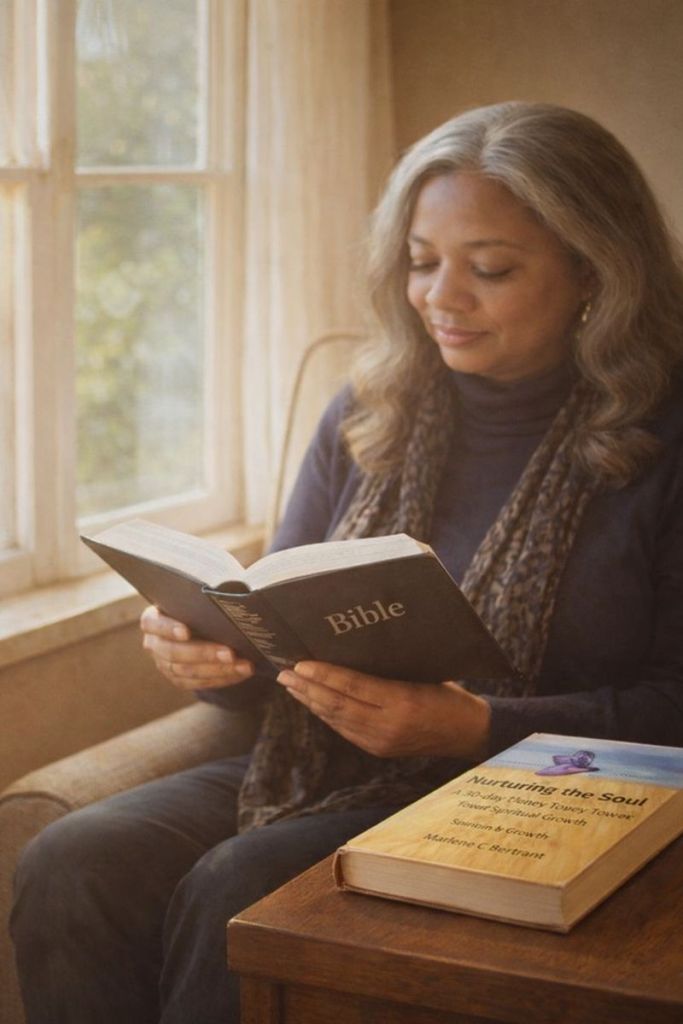
Marlene reading the bible.

In a world that constantly pulls at our attention, many of us feel spiritually tired, even when our faith is strong. Life moves fast. Responsibilities pile up. Noise surrounds us. And somewhere along the way, our souls quietly ask for care.

That is exactly why Nurturing the Soul: A 30-Day Journey Toward Spiritual Growth was written.

This book was created for people who desire a deeper connection with God but may feel overwhelmed, disconnected, or unsure where to begin. It is not about perfection. It is not about checking spiritual boxes. It is about creating intentional moments, small, meaningful pauses, to reconnect with God, reflect on life, and allow the soul to breathe again.

Why Nurturing the Soul Matters

We spend so much time nurturing others, our families, our careers, our communities, that we often neglect our inner life. Yet the soul needs care just as much as the body and mind. When the soul is neglected, it shows up as exhaustion, discouragement, and spiritual dryness.

Nurturing the Soul invites readers to slow down and return to the basics of faith: reflection, prayer, Scripture, and honest conversation with God. Each day of the 30-day journey is designed to gently guide the reader into deeper awareness, healing, and spiritual renewal.

This is not a book you rush through. It’s a book you sit with. A book you open each day as a sacred appointment with God.

What the 30-Day Journey Looks Like

Each day in Nurturing the Soul offers:

  • A focused spiritual theme
  • A carefully selected Bible verse
  • A devotional reflection meant to encourage, challenge, and uplift
  • Gentle prompts that invite personal reflection and prayer

The journey is structured, but flexible. Whether you are new to daily devotionals or returning after a long break, this book meets you exactly where you are.

Some days will feel comforting. Others may stir deep emotions. All of them are designed to help you grow spiritually, emotionally, and personally.

The Companion Journal: Going Deeper

Alongside the book is the Nurturing the Soul: 30-Day Companion Journal, created for those who want to go deeper in their reflection.

The journal is not an afterthought; it is an intentional extension of the journey. Writing has a powerful way of bringing clarity to thoughts, healing to emotions, and depth to prayer. The Companion Journal provides dedicated space to:

  • Respond to daily prompts
  • Record prayers and spiritual insights
  • Reflect honestly without judgment
  • Track growth over the 30-day journey

Many readers find that journaling transforms reading into an experience. It turns inspiration into action and reflection into lasting change.

Together, the book and journal create a sacred rhythm: read, reflect, write, pray, and grow.

Who This Journey Is For

Nurturing the Soul is for:

  • Anyone feeling spiritually weary or disconnected
  • Believers seeking renewal without pressure or guilt
  • Those navigating life transitions, grief, or uncertainty
  • Readers who desire a quieter, more intentional faith practice

You do not need to have all the answers. You simply need a willing heart.

An Invitation and How to Begin

If your soul has been longing for stillness, clarity, or renewed faith, this journey is for you.

Nurturing the Soul: A 30-Day Journey Toward Spiritual Growth and the accompanying 30-Day Companion Journal are both available on Amazon, making it easy to begin whenever you’re ready.

Simply visit Amazon, search for “Nurturing the Soul: A 30-Day Journey Toward Spiritual Growth,” and consider pairing it with the 30-Day Companion Journal for a richer, more transformative experience.

Your soul deserves care.
Your faith deserves time.
And your journey can begin today: one day at a time.

This World is Not Our Final Home

We are not meant to find our peace or fulfillment in this broken world. The hurt we experience here is temporary, no matter how deep it feels.

Everywhere we look today, it feels like the world is unraveling. People lash out in anger, friendships are torn apart, and love seems to grow colder by the day. It’s heartbreaking to witness how easily kindness is forgotten and how often relationships are sacrificed over pride, selfishness, or misunderstanding. 

For those who are on the receiving end of pain, betrayal, rejection, or cruelty, it’s natural to feel the urge to fight back, to retaliate, to defend your heart. But God’s Word calls us to something higher. Hebrews 13:14 (NLT) reminds us, “For this world is not our permanent home; we are looking forward to a home yet to come.” This truth gives us the strength to respond differently. 

We are not meant to find our peace or fulfillment in this broken world. The hurt we experience here is temporary, no matter how deep it feels. Our citizenship is not of this earth; Philippians 3:20 (NLT) declares, “But we are citizens of heaven, where the Lord Jesus Christ lives. And we are eagerly waiting for him to return as our Savior.”

When we remember that heaven is our true home, we gain perspective. The pain others inflict doesn’t define us; it refines us. Every trial becomes an opportunity to draw closer to Christ, to model His grace, and to reflect His light in the darkness. 

So, when you feel like the world is falling apart around you, take heart. God sees your tears. He knows your hurt. And He promises that one day, all wrongs will be made right. Until then, walk in peace, love without fear, and keep your eyes fixed on the home that awaits you, where there will be no more sorrow, no more betrayal, and no more pain. 

Heaven is our final destination. Let’s live each day with that hope in our hearts. 

Related Song: This World Is Falling Apart

For anyone who has been hurt by the players in this world, remember, this world may be harsh, but we have heaven to look forward to. Please click to hear the song and video inspired by Hebrews 13:14 and Philippians 3:20.

Speaking Life: The Power of Words in Shaping Your Day

Each word we release into the world either strengthens a bridge of grace or erects a wall of division.

Scripture Reading
The tongue has the power of life and death, and those who love it will eat its fruit.— Proverbs 18:21

Do not let any unwholesome talk come out of your mouths, but only what is helpful for building others up according to their needs, that it may benefit those who listen.— Ephesians 4:29

Reflection
Our words hold extraordinary power. Every sentence we speak is either a bridge that connects hearts or a wall that divides them. Words can lift someone from despair or push them deeper into darkness. They can heal or wound, encourage or discourage, inspire faith or sow doubt.

I’m 70 years old now, and I still remember the moment I felt like the ugliest person on the planet. I was about nine years old when a lady came to visit one day. Upon seeing me, she smiled and said, “You’re so pretty!” Quickly, another woman in the room said, “Don’t tell her that, or else she’ll believe you.” This woman bent down to me and continued, “Honey, if someone ever says you’re pretty, they are just trying to be nice.” My feelings were hurt, and I swiftly left the room and stayed in my bedroom for the rest of the day.

Growing up, I would stay away from people or make sure my head was down so that people couldn’t get a good look at my face. If I had to be in front of people, I would wear bangs so they wouldn’t be able to see my whole face. My inner critic constantly told me I was not good enough. I had trouble trusting people, and this distrust manifested in deep-seated anxiety over being in public and speaking to people, much more, talking to a crowd.

The words I heard as a child became the foundation for the person I became as an adult: crippled by self-doubt and unable to see my self-worth.

God designed language not merely as a tool for communication but as a vessel for His truth and love. When we speak blessings, we align our hearts with His divine purpose. Life-giving words carry the light of Christ into places where shadows linger. A kind word spoken in love can ignite hope in a weary soul.

Conversely, careless or harsh words can tear down trust and build barriers that separate us from others, as well as from God’s peace within us. That’s why Scripture continually reminds us to be slow to speak and quick to listen. Each word we release into the world either strengthens a bridge of grace or erects a wall of division.

Let us choose to be bridge builders, people who speak with gentleness, encouragement, and truth. Our voices can become instruments of healing that reflect God’s mercy and draw others closer to His heart.

Application
I am grateful to have learned about the benefits of affirmations. Affirmations are powerful and positive statements that we can use to speak to ourselves.

When repeated, they work well, especially when repeated often. They can replace negative feelings with a sense of peace.

Use affirmations to build up your strength and gain the peace you deserve. Speak one uplifting word or sentence over yourself today.

Prayer
Heavenly Father,
Help me to use my words wisely and with love. Guard my tongue so that what I speak builds bridges, not walls. Let my words bring comfort, encouragement, and truth to those who hear them. Fill my heart with Your Spirit so that every conversation reflects Your grace. May my speech be seasoned with kindness, drawing others toward Your light and peace.
In Jesus’ name, Amen.

Morning Rhythms: Starting the Day with Peace and Purpose

How we start our day often shapes how it will end. When we begin with prayer and thanksgiving, we invite peace, hope, love, and joy to accompany us through every moment.

Have you ever noticed how the way you start your morning sets the tone for the rest of your day?


In this post, I share how beginning each morning with prayer, gratitude, and quiet time with God can transform your outlook and bring calm to even the busiest days.

Scripture Reading

Because of the Lord’s great love we are not consumed, for his compassions never fail. They are new every morning; great is your faithfulness.
— Lamentations 3:22–23 (NIV)

In the morning, Lord, you hear my voice; in the morning I lay my requests before you and wait expectantly.
— Psalm 5:3 (NIV)

Retrospection

Each morning, before my feet touch the floor, I take a few quiet moments to thank the Lord for the gift of a new day, another opportunity to live, to work, and to become more like the person He desires me to be. In those still moments, I lift my family and friends to Him. I offer my business dealings, my plans, and my concerns, asking God to stay at the center of everything I do.

When my time of prayer ends, I move on to the morning routine, which includes showering, drinking coffee, and preparing for the day ahead. Yet, before diving into tasks, I open my Bible. Reading His Word helps me align my thoughts with His will. I reflect on how I can apply His truth to my life so that others might see His light shining through me.

There was a time when I used to start my mornings differently. My first priority was checking emails, returning calls, and jumping into the day’s responsibilities. Only after I had worked through my to-do list did I turn my attention to God. But over time, I noticed a pattern; those days often felt rushed, unsettled, and incomplete.

Eventually, I discovered a profound truth: when I start my day with God, everything else unfolds with greater peace and purpose. Prayer and gratitude at the start of the day lay a foundation for wise decisions and calm perseverance. When I seek His guidance first, His blessings seem to accompany every step thereafter.

Time with God is essential to a life filled with hope and lasting peace. For some, mornings are the perfect time to meet with Him; for others, it may be during a quiet lunch break or in the stillness of the evening. The specific time is not what matters most. What matters is consistency and a heart open to His presence.

Each new morning symbolizes renewal. God’s mercies are fresh every day, and He listens to every word we speak. Knowing that, I want my first words to be to Him, words of gratitude, praise, and surrender.

Developing a habit of spending time with God daily transforms not only our mornings but our entire lives. How we start our day often shapes how it will end. When we begin with prayer and thanksgiving, we invite peace, hope, love, and joy to accompany us through every moment.

Application

Tomorrow morning, begin with five minutes of silence and gratitude. Whisper a simple prayer of thanks, invite God into your day, and let His presence guide every step you take.

Closing Prayer

Heavenly Father,
Thank You for the gift of a new morning and the promise of Your unfailing love. Help me to start each day by turning my heart toward You. Teach me to rest in Your peace before the world’s noise begins, and to carry Your presence with me through every task and conversation. May my mornings be filled with gratitude, my days with purpose, and my nights with peace.
In Jesus’ name, Amen.

Walking Lightly: Simplifying Life to Make Space for God

An uncluttered life makes it easier to hear God’s whisper.

Scripture Reading:
“Do not store up for yourselves treasures on earth, where moths and vermin destroy, and where thieves break in and steal. But store up for yourselves treasures in heaven, where moths and vermin do not destroy, and where thieves do not break in and steal. For where your treasure is, there your heart will be also.”
— Matthew 6:19–21 (NIV)

“He says, ‘Be still, and know that I am God; I will be exalted among the nations, I will be exalted in the earth.’”
— Psalm 46:10 (NIV)

Retrospection:

There’s an old saying: “Cleanliness is next to godliness.” While it’s not a direct Bible verse, the phrase encourages us to keep our hearts pure and our lives in good order. It is a call to live with integrity and spiritual mindfulness.

If that’s the standard, I’ve always considered myself a “clean” person. But along with that, I’ve also been a busy person. Much of what fills my days involves church work or spiritually centered projects. Still, I’ve never heard anyone say, “Busyness is next to godliness.”

From sunrise to sunset, I often find myself shifting from one task to another, answering messages, helping others, and attending to my home and work. I always make time to begin my day with God, but as the hours pass, my schedule tends to take on a life of its own. Although I view my diligence as a commitment, I’ve learned that constant busyness can blur the line between devotion and distraction.

One turning point came when I volunteered to help a friend with an event. I worked tirelessly, one task led to another, until I realized I had gone twenty-four hours without sleep. My body gave in, and in that exhausted state, I began hallucinating. It was frightening. That experience humbled me and reminded me that, even as I serve others, I must also care for the temple God gave me, my body and spirit.

Since then, I’ve made a conscious effort to slow down. Scaling back my commitments hasn’t been easy, but as I began to simplify, I found something beautiful: clarity. With fewer distractions, I became more aware of God’s presence throughout my day. My prayers deepened, my thoughts quieted, and peace began to fill the spaces where stress once lived.

I no longer schedule time for God; instead, my life revolves around Him. I’ve learned that walking lightly, shedding unnecessary clutter and commitments, opens more room for God to dwell in my heart.

I am happy to have discovered how an uncluttered life makes it easier to hear God’s whisper.

Application:

Choose one area of your life to simplify this week: your time, your space, or your commitments. Ask yourself: What can I release to create more room for God’s peace to settle in my soul?

Prayer:

Heavenly Father,
Teach me to walk lightly and live simply, trusting that You are all I need. Help me release the weight of unnecessary busyness and worldly pursuits that crowd my heart. Fill the quiet spaces of my life with Your peace and presence. May my days flow from a place of stillness, not striving, and may every moment reflect my devotion to You.
In Jesus’ name, I pray. Amen.